Key findings
- Staten Island filed 2,026 rodent complaints to 311 between January 2025 and October 2026. NYC Open Data
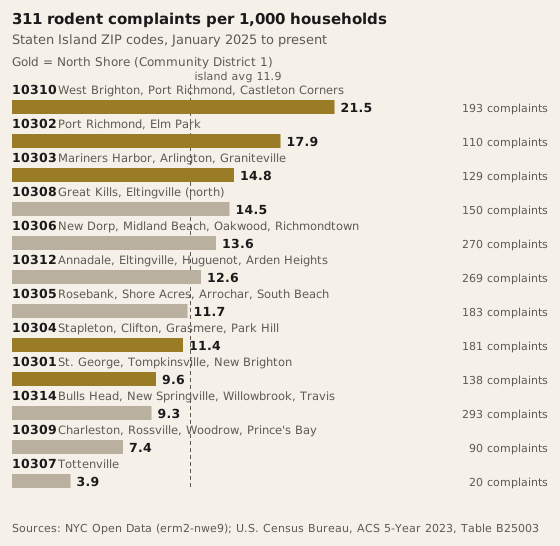
- ZIP 10310 — West Brighton, Port Richmond, Castleton Corners and Randall Manor — reports the most rats on the island, at 21.5 complaints per 1,000 households, nearly double the island average of 11.9. Our analysis of NYC Open Data and U.S. Census data
- The three highest-reporting ZIP codes on Staten Island are all on the North Shore. The North Shore reports 13.9 complaints per 1,000 households against 11.0 for the rest of the island. Our analysis
- In 2025 the Health Department inspected 0.8% of Staten Island properties for rats, compared with 71.8% in Manhattan and 11.8% citywide. NYC Health
- Staten Island inspection coverage has more than halved since 2023, from 1.7% to 0.8%, while Manhattan held steady near 71%. The gap widened from 42x to 90x. NYC Health
- Reported 311 complaints are falling on Staten Island — down 9.4% in 2025 — but the share of Staten Island homes reporting mice or rats rose from 7.3% in 2021 to 10.5% in 2023, a 44% increase and the fastest of any borough. The confidence intervals do not overlap, so the rise is statistically meaningful. NYC Open Data; NYC Health
- The gap between the highest- and lowest-reporting ZIP codes is 5.5 times: 21.5 per 1,000 households in 10310, against 3.9 in Tottenville. Our analysis
Which Staten Island neighborhoods report the most rats?
ZIP 10310 — West Brighton, Port Richmond, Castleton Corners and Randall Manor — reports 21.5 rodent complaints per 1,000 households, nearly double the island-wide average of 11.9. The three highest rates on Staten Island are all North Shore ZIP codes.
This is an original analysis. We pulled every rodent complaint filed with 311 from Staten Island since January 2025 from NYC Open Data, then divided by the number of occupied households in each ZIP code from the Census Bureau.
That second step matters more than it sounds. By raw count the busiest ZIP code is 10314 — Bulls Head, New Springville, Willowbrook and Travis — with 293 complaints. It is also the most populous ZIP code on the island. Measured per household it ranks tenth of twelve. Counting complaints without accounting for how many people live somewhere mostly tells you where the people are.
| ZIP | Neighborhoods | Complaints | Households | Per 1,000 |
|---|---|---|---|---|
| 10310 | West Brighton, Port Richmond, Castleton Corners, Randall Manor | 193 | 8,982 | 21.5 |
| 10302 | Port Richmond, Elm Park | 110 | 6,159 | 17.9 |
| 10303 | Mariners Harbor, Arlington, Graniteville, Port Ivory | 129 | 8,742 | 14.8 |
| 10308 | Great Kills, Eltingville (north) | 150 | 10,323 | 14.5 |
| 10306 | New Dorp, Midland Beach, Oakwood, Bay Terrace, Richmondtown | 270 | 19,846 | 13.6 |
| 10312 | Annadale, Eltingville, Huguenot, Arden Heights, Greenridge | 269 | 21,366 | 12.6 |
| 10305 | Rosebank, Shore Acres, Arrochar, South Beach, Dongan Hills | 183 | 15,637 | 11.7 |
| 10304 | Stapleton, Clifton, Grasmere, Concord, Park Hill | 181 | 15,900 | 11.4 |
| 10301 | St. George, Tompkinsville, New Brighton, Silver Lake | 138 | 14,430 | 9.6 |
| 10314 | Bulls Head, New Springville, Willowbrook, Travis, Westerleigh | 293 | 31,419 | 9.3 |
| 10309 | Charleston, Rossville, Woodrow, Prince's Bay | 90 | 12,108 | 7.4 |
| 10307 | Tottenville | 20 | 5,135 | 3.9 |
Complaint counts: NYC Open Data, 311 Service Requests (dataset erm2-nwe9), complaint type “Rodent”, borough Staten Island, created on or after 1 January 2025. Households: U.S. Census Bureau, American Community Survey 5-Year Estimates 2023, Table B25003 (occupied housing units) by ZIP Code Tabulation Area.
One caveat, stated plainly: 311 data measures where rats get reported, not where they live. A neighborhood that calls 311 more often will look worse than one that does not, regardless of actual rodent pressure. Read this as a map of reported activity, not a census of rats.
Manhattan properties are inspected for rats 90 times more often than Staten Island’s
In 2025 the Health Department inspected 0.8% of Staten Island tax lots for rats. The citywide figure was 11.8%. In Manhattan it was 71.8%.
| Borough | Properties inspected | Failed, any reason | Active rat signs |
|---|---|---|---|
| Manhattan | 71.8% | 15.0% | 13.1% |
| Bronx | 23.4% | 7.3% | 4.9% |
| Brooklyn | 15.2% | 3.6% | 3.1% |
| Queens | 2.1% | 0.8% | 0.5% |
| Staten Island | 0.8% | 0.2% | 0.0% |
| New York City | 11.8% | 3.0% | 2.4% |
NYC Health Department, Environment & Health Data Portal, Rat inspections indicator, 2025. Figures are a share of all tax lots.
The gap has more than doubled since 2023
Staten Island's inspection coverage has more than halved in two years, from 1.7% of properties in 2023 to 0.8% in 2025, while Manhattan's held steady at around 71%. In 2023 Manhattan properties were inspected about 42 times as often as Staten Island's. By 2025 that ratio had grown to 90 times.
| Borough | 2022 | 2023 | 2024 | 2025 | Change |
|---|---|---|---|---|---|
| Manhattan | 71.5% | 71.4% | 75.1% | 71.8% | — |
| Bronx | 36.1% | 36.2% | 19.6% | 23.4% | −35% |
| Brooklyn | 14.7% | 10.2% | 15.9% | 15.2% | +3% |
| Queens | 2.2% | 2.2% | 2.7% | 2.1% | −5% |
| Staten Island | 1.2% | 1.7% | 0.9% | 0.8% | −33% |
| New York City | 13.1% | 11.7% | 12.0% | 11.8% | −10% |
NYC Health Department, Environment & Health Data Portal, Rat inspections indicator. Change column compares 2025 with 2022.
Staten Island is not alone in seeing coverage fall — the Bronx dropped by roughly a third over the same period, and citywide coverage is down about 10%. But Staten Island started from the lowest base in the city and has fallen the furthest from it. Every one of the island's three community districts now sits at or below 1.2%, with Tottenville and Great Kills at 0.6%.
This is a difference in programme design, not neglect. The Health Department uses a technique called rat indexing, inspecting every property in a targeted area whether or not anyone has complained, and it concentrates that effort where rat activity is already known to be heavy. None of the city's four Rat Mitigation Zones is on Staten Island. The department states plainly that because the Bronx and Manhattan are indexed proactively, inspection findings in those boroughs should not be compared with the other boroughs.
The practical consequence for a Staten Island property owner is simple. Inspections here are almost entirely complaint-driven, so a rat problem on your block will not appear in city data until somebody reports it — and Staten Island's active-rat-signs figure rounds to 0.0% at borough level, which reflects the near-absence of inspections rather than the absence of rats. That is why the 311 reports above are the more useful signal on this island.
| Community district | Properties inspected | Failed, any reason | Active rat signs |
|---|---|---|---|
| CD 1: St. George & Stapleton (North Shore) | 1.2% | 0.4% | 0.1% |
| CD 2: South Beach & Willowbrook (Mid-Island) | 0.7% | 0.2% | 0.0% |
| CD 3: Tottenville & Great Kills (South Shore) | 0.6% | 0.1% | 0.0% |
NYC Health Department, 2025. We have deliberately not converted these into a per-inspected-property rate: with under 1.2% of lots inspected, dividing by that base multiplies rounding error more than a hundredfold.
Is the Staten Island rat problem getting better or worse?
It depends which measure you trust, and we think both deserve stating.
Reported complaints are falling. Staten Island recorded roughly 1,130 rodent complaints in calendar 2025, down about 9.4% on the previous year, part of a citywide decline.
Household surveys point the other way. The share of Staten Island households reporting mice or rats in their home or building rose from 7.3% in 2021 to 10.5% in 2023 — a 44% relative increase, the largest of any borough by some distance. Staten Island still has the lowest rate in the city, but it is the only borough rising this fast.
This is not survey noise. The 95% confidence interval for 2021 runs from 6.0% to 8.6%, and for 2023 from 9.0% to 12.0%. The two ranges do not overlap, which means the increase is statistically meaningful rather than a sampling artefact.
| Borough | 2021 | 2023 | Relative change |
|---|---|---|---|
| Staten Island | 7.3% | 10.5% | +44% |
| Brooklyn | 23.6% | 28.8% | +22% |
| Bronx | 38.2% | 42.2% | +11% |
| Queens | 18.7% | 20.6% | +10% |
| Manhattan | 25.6% | 24.5% | −4% |
| New York City | 24.3% | 26.8% | +10% |
NYC Health Department, Environment & Health Data Portal, drawn from the New York City Housing and Vacancy Survey. The survey is conducted roughly every three years; 2023 is the most recent.
These are not contradictory so much as different instruments. One counts people who picked up the phone; the other asks a representative sample what they are living with. Fewer complaints can mean fewer rats, or it can mean fewer calls.
What the city is doing about it on the North Shore
Community District 1 — covering Stapleton, Randall Manor, Westerleigh, West Brighton, Clifton and Shore Acres — is one of the districts selected for full on-street trash containerisation by the end of 2027. Containerising waste removes the open food supply that lets a rat population grow.
It is worth noting that the ZIP codes reporting the most rats on Staten Island sit largely inside that district. Buildings changing their waste setup also tend to see rodent pressure shift while the change beds in, which is a reason for property managers in those neighborhoods to pay attention over the next two years rather than after.
Why a rat problem is worth fixing early
It is a health issue, not just an unpleasant one
Rat urine can spread leptospirosis, a bacterial infection that can cause kidney failure, liver damage, meningitis and respiratory distress. New York City recorded 24 human cases in 2023, the highest number in any single year, against an average of about 3 cases a year between 2001 and 2020 and 15 a year from 2021 to 2023. NYC Health Advisory
The Health Department reports that local cases typically follow residential or occupational contact with rat urine, or with soil, water and materials contaminated by it — including handling trash bags or bins containing food waste. Between 2001 and 2023 the city recorded 98 locally acquired cases and six deaths.
In context: Staten Island accounted for 4 of those 98 cases, the fewest of any borough, against 37 in the Bronx and 28 in Manhattan. Human leptospirosis is rare here and we are not going to pretend otherwise. The point is that the mechanism is real, the citywide trend is upward, and the exposure route is an ordinary one — taking out the trash.
Dogs are the more immediate concern on an island with this many yards. Dogs contract leptospirosis from the same source, and the disease drew attention in the city after several dogs were reported to have died following possible exposure at a Brooklyn dog run. There is a canine vaccine; ask your vet.
Separately, mouse and rat droppings and dander worsen asthma, which the Health Department lists among the household triggers it advises families to control.
On Staten Island, remediation is legally your responsibility
Under the New York City Health Code, keeping a property free of rats and of the conditions that attract them is the owner's obligation. When an inspection finds active signs, the Health Department can issue a Commissioner's Order to Abate, and failing a follow-up inspection can result in a summons under section 151.02 of the Health Code. The city can also perform the extermination itself and bill the owner. A violation is cheaper to avoid than to answer.
For a business, rats are a reputation problem before they are a pest problem
For food service, the stakes are posted in the window: the Health Department's letter grade is driven by a point system in which pest evidence carries real weight, and a single finding behind a prep table can move an A to a B. For any customer-facing business, one rat seen by one customer travels further than any amount of advertising. Rodents also gnaw — wiring, packaging, stock — and contaminate far more food than they eat.
At home, the damage is usually hidden
Rats and mice gnaw constantly, and that includes electrical wiring inside walls and in garages, sheds and crawl spaces where nobody is looking. They burrow under decks, sheds and foundation slabs. And most households discover the problem when they hear it at night rather than when it starts, by which point a pair has usually become a population.
The common thread: it compounds
A rat problem does not hold steady. A breeding pair becomes a colony in a season, and the cost and difficulty of clearing it rises with every month it runs. The cheapest version of this problem is the one you deal with in the first week.
What to do if you are seeing rats on Staten Island
Report it to 311. It is free, and on an island where only 0.8% of properties are inspected proactively, a complaint is most of what puts your block on the city's map at all.
Remove the food and water. Garbage in hard containers with tight lids, no open bags left out overnight, pet food indoors, standing water cleared.
Close the entry points. A rat needs a gap the size of a quarter and a mouse one the size of a dime. Check where utility lines enter the foundation, around garage door seals, and vents and crawl space openings.
Do not seal an active burrow or entry without treating first. Blocking the only way out of an occupied harbourage pushes rodents further into the structure, which is a worse problem than the one you started with.
For a closer look at how rodents get into houses here, see our field notes on where mice actually get in.
Seeing rats or droppings? Text us a photo.
We are a licensed pest control business based on Staten Island, working across the island, Brooklyn and Central New Jersey — including evenings and weekends, so treatment does not have to happen in the middle of your business day. Send a photo of what you are seeing, where it is, and a short description, and we will tell you what you are dealing with.
Our services: rodent and wildlife removal · restaurants and food service · apartment buildings and property management · areas we serve